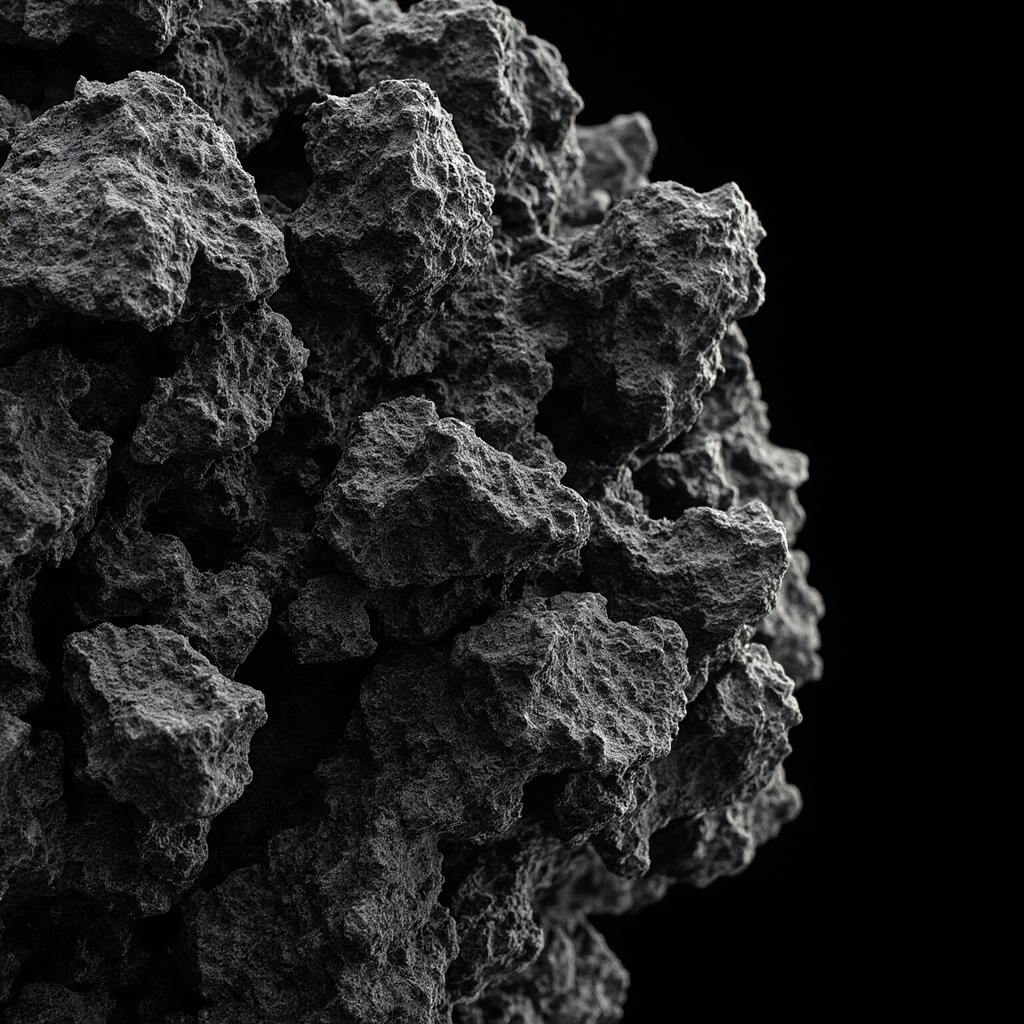
 If you think all High-Carbon Graphite looks the same under a microscope, you are missing the entire plot. The truth is, the origin of the graphite—whether it’s mined from a specific vein in Sri Lanka, exfoliated from a Chinese flake deposit, or synthesized in a reactor—leaves a fingerprint that is as distinct as a human iris. This is not just a geology lesson; it is a critical decision point for anyone buying graphite for high-performance applications like battery anodes, lubricants, or refractory materials.
Let’s cut through the noise. The morphology of your graphite dictates how it behaves. A spherical particle from a synthetic process will pack differently than a jagged, flake-like particle from a natural deposit. The “Microstructure Atlas” we are talking about is the cheat sheet that separates the engineers who get consistent results from those who are constantly fighting batch-to-batch variation.
Take the classic Madagascar flake. Under the lens, it looks like a stack of thin, overlapping plates. This structure is a dream for thermal conductivity because the basal planes are highly aligned. But here is the kicker: if you need high compressibility for a powder metallurgy application, that same flake will crumble unpredictably. Now compare that to a synthetic graphite nodule. It is dense, rounded, and looks like a cauliflower under high magnification. That morphology gives you superior flowability and a much lower surface area, which is a lifesaver when you are trying to control binder demand in carbon electrodes.
Why does this matter for your bottom line? Because the wrong morphology is a hidden tax on your production line. If you are sourcing graphite from a supplier who cannot tell you the specific origin and its associated microstructure, you are gambling. A “high-carbon” label is meaningless without the context of the source. A vein graphite from Sri Lanka, for instance, shows a fibrous, columnar structure that is almost pure crystalline perfection. It is the gold standard for lubricity, but it is also brittle. A flake graphite from Brazil might have a rougher edge structure, which actually helps with mechanical interlocking in brake pads.
The real power move here is to stop treating graphite as a commodity. Start treating it as a material with a passport. When you know the origin, you predict the performance. Our product line offers a curated selection of these origin-specific morphologies, backed by a full microstructure atlas. We do not just sell you “high-carbon graphite.” We sell you the exact particle shape, the precise crystallinity, and the predictable behavior that your process demands.
Stop squinting at a black powder and hoping for the best. Look at the atlas. Know the origin. Control the outcome. That is the difference between a material that works and a material that excels.